
 简体中文
简体中文Search for More Information


Research on the Localization and Adaptation of Linear Motion Systems: A Case Study of RYK Modules in High-Speed SMT Placement Machine Applications
High-end SMT placement machines serve as core equipment in precision electronics manufacturing, Mini LED packaging, and semiconductor assembly processes. The throughput and placement yield of these machines depend heavily on the high-speed dynamic response capabilities and micron-level positioning stability of their linear motion systems.
While domestic high-end SMT equipment manufacturers have recently achieved technological breakthroughs in vision algorithms and overall machine control architectures, the core linear motion execution units remain heavily reliant on imports. This reliance presents structural shortcomings—such as long lead times, limited customization flexibility, and high comprehensive operation and maintenance costs—which have become critical bottlenecks hindering the full localization of high-end SMT equipment. Based on an iterative development project for a high-speed SMT placement machine by Muji Intelligence, this paper analyzes the technical mechanisms behind the RYK dual-module collaborative drive solution (combining synchronous belts and lead screws). It specifically addresses the differentiated operational requirements of the machine's axes—namely, long-stroke high-speed translation and precise vertical positioning. By validating the feasibility of substituting imported components with domestically produced modules using actual mass-production test data, this study provides a technical basis for component selection in the localization of motion systems for precision electronics manufacturing equipment.
High-speed SMT placement machines employ a dual-axis collaborative operational logic: the X-axis executes large-range, high-speed horizontal translation, while the Z-axis performs precise vertical placement. The operational parameters and technical constraints for these two distinct types of axes differ significantly.
The X-axis, with its 1200mm stroke, undergoes continuous high-speed reciprocating motion at 1.8 m/s; this operation is prone to issues such as structural deformation over long spans, high-speed resonance, and dynamic positioning deviations.
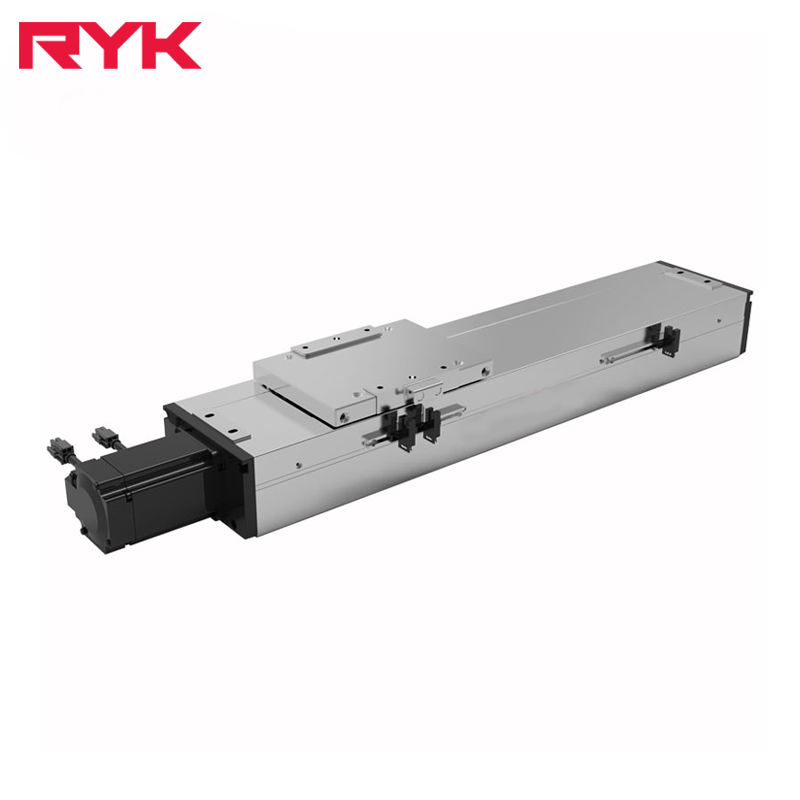
The Z-axis is required to support an 8kg placement load while maintaining a repetitive positioning accuracy of ±0.01mm under high-frequency start-stop conditions; consequently, it faces stringent requirements regarding dynamic drift resistance and structural rigidity.
Although traditional imported module solutions can satisfy basic process standards, their 4–6 week lead times, high customization costs, and rigid standardized specifications fail to meet the core requirements of domestic equipment manufacturers—specifically, the need for rapid product iteration, structural optimization, and cost reduction in mass production.
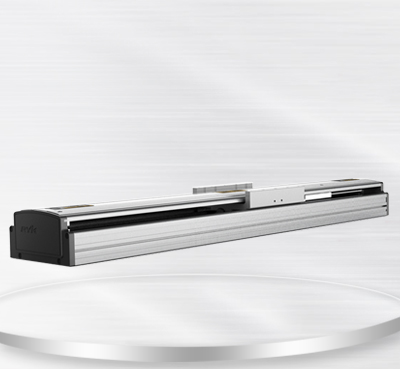
To address the distinct operational constraints of these two axes, the project adopted a collaborative dual-module architecture tailored to specific operational segments, thereby achieving an optimal balance between high-speed motion performance and precise positioning accuracy. The X-axis is equipped with the RYK-KK100 synchronous belt module. Leveraging the non-contact physical properties of synchronous belt transmission, it effectively circumvents issues—such as long-span sagging, high-speed resonance, and thermal drift—that typically arise from the length-to-diameter ratio limitations inherent in lead screw mechanisms.
The module supports a maximum travel range of 5 meters with a rated speed of up to 2 m/s; it features ample operational margin to accommodate continuous high-speed operation at 1.8 m/s.
By integrating lightweight, high-rigidity profiles with a low-inertia transmission design, the system significantly enhances acceleration and deceleration response speeds, suppresses oscillation during high-speed direction reversals, and ensures the smoothness and continuity of long-distance trajectory movements.
The Z-axis is fitted with the RY60 precision lead screw module, designed to meet the micron-level positioning requirements for vertical placement applications. This module features an imported, precision-ground ball screw paired with a pre-loaded, anti-backlash structure that completely eliminates transmission clearance, thereby consistently achieving a repetitive positioning accuracy of ±0.01 mm.
The module body is constructed from stress-relieved, aged aluminum-magnesium alloy. Through an integrated motor mount design and a "single-cut" precision machining process for the base, the system strictly controls coaxiality errors in transmission and structural deviations across the full travel range. This design effectively prevents structural deformation and accuracy drift—issues often triggered by high-frequency vertical movements or sustained loads. Furthermore, the module integrates seamlessly with the equipment's proprietary servo control system, perfectly aligning with the timing control logic required for precise component pickup and placement.
Validated through 24 hours of continuous aging tests and extensive mass production runs, this localized dual-axis collaborative solution has fully met all performance benchmarks. Compared to imported solutions, this system demonstrates a 30% improvement in the consistency of placement accuracy during mass production.
Following the optimization of motion timing sequences, the overall placement throughput of the machine has increased by 50%, with actual measured placement speeds reaching 92,000–98,000 CPH—thereby satisfying the high-precision and high-throughput placement demands for Mini LED micro-components.
From a supply chain perspective, the lead time for these localized modules has been reduced to just 3–5 business days, while the total cost of the complete motion system has dropped by 35%. Additionally, the system supports custom non-standard structural interfaces, effectively resolving the critical pain point regarding the limited adaptability of imported components during equipment iteration and upgrades.
Empirical data confirms that, through a differentiated selection strategy—which involves segmenting operational scenarios and leveraging specific strengths while mitigating weaknesses—the RYK high-speed, high-precision collaborative solution serves as a fully viable substitute for imported linear motion systems. This adaptation principle is applicable across a wide range of precision manufacturing scenarios—including semiconductor packaging, precision assembly for 3C products, mass transfer, and automotive electronics assembly—providing a practical, replicable, and standardized technical solution that facilitates the localization of motion systems for high-end electronic manufacturing equipment, drives cost reduction and efficiency gains, and enables rapid technological iteration.